February 2026, Glare and Polarizing Filters – II

Description automatically generated" >
February 2026, Glare and Polarizing Filters – II
Dear Dru,
News about happenings at Deliberate Light and photography instruction (see Digital Photo Academy). My views on this month’s photography topic: Glare and Polarizing FIlters.
NEWS
Upcoming Workshops. I am next scheduled to teach workshops for Digital Photo Academy on May 2nd, 2026 at Rittenhouse Square Park in Philadelphia. You can sign up here.
- Mastering Your Camera Controls (1.5 hours) – intended for DSLR/Mirrorless/Compact cameras (smartphone tutorial available separately)
- Composition in the Field (3 hours) – walking tour around the venue with instruction and hands-on practice composing photos (bring any camera)
New Photo.
Kitty Contemplates Snow with Disdain. Visiting a good friend who had just lost his wife a month before, I wanted some uplifting photos, but I got this rather dreary photo instead. Despite that, I rather liked it because it reminded me of the muted tones of an Andrew Wyeth painting, who haunted the same part of the country. Not that my photo compares to Andrew Wyeth, but it looked like a scene he might have liked.
(Kennett Square, 2026)
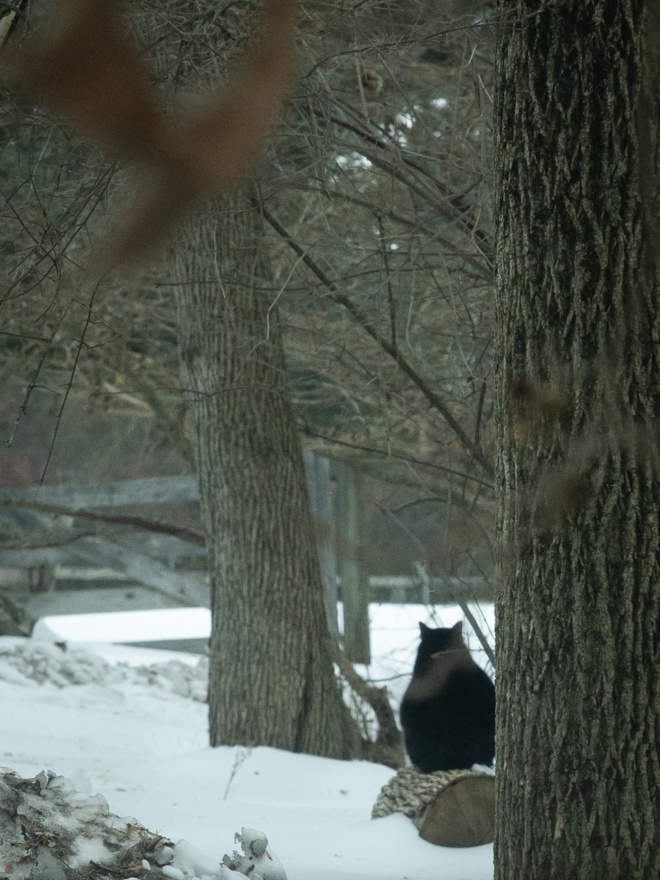
For a more detailed, enlarged view, see it on my website.
VIEWS
Glare and Polarizing Filters – their effects and how to use them
Outdoor photographers routinely use polarizing filters on camera lenses (including on cellphone cameras) to reduce or eliminate “glare”. But they do not always work with significant photographic challenges arising because there are different kinds of polarization of light and because a scenario will often have a mixture of un-polarized and polarized light. Last month we learned about polarized light. This month, we focus on the effect of polarized light on glare and how filters can be used to reduce it. A pretty tech-y topic and not one accompanied by beautiful images, but I find it fascinating, so here goes.
I showed the following image last month as an illustration of different kinds of glare in a picture without steps taken to reduce it. Note the glare from the monitor and its reflection on the tabletop, as well as the glare from the window light on the front edge of the table and the two pictures on the desk.
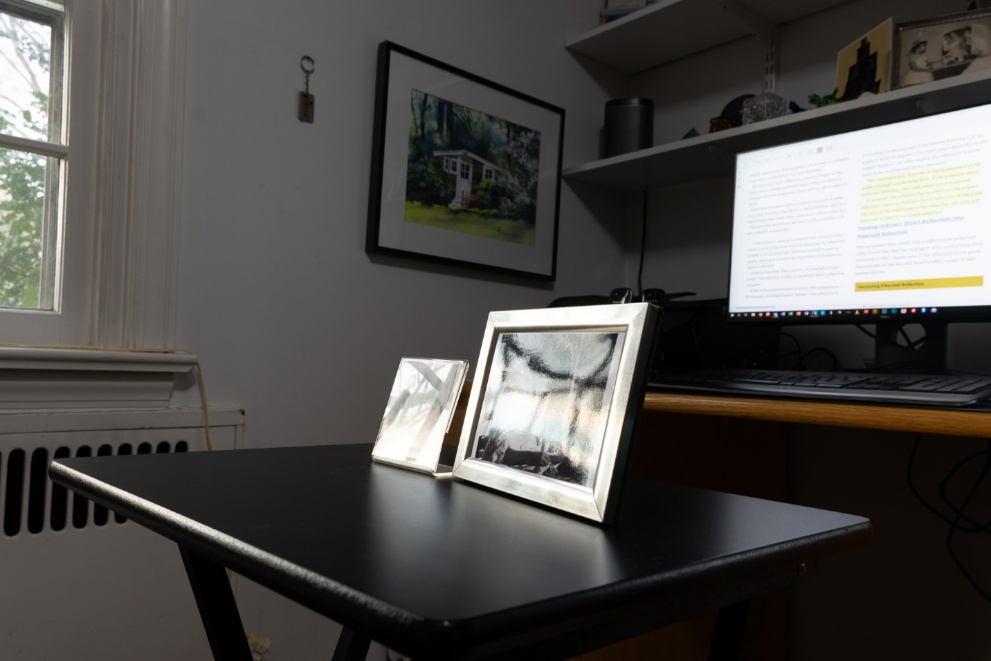
The next photos were both shot within one minute of the above photo using the same camera on a tripod in the same position with the same camera settings. The only difference is that the next two photos used a polarizing lens filter, each having a different rotation of the polarizing filter. The images are not edited.
In this image, the filter is rotated to block the polarized light from outdoors.
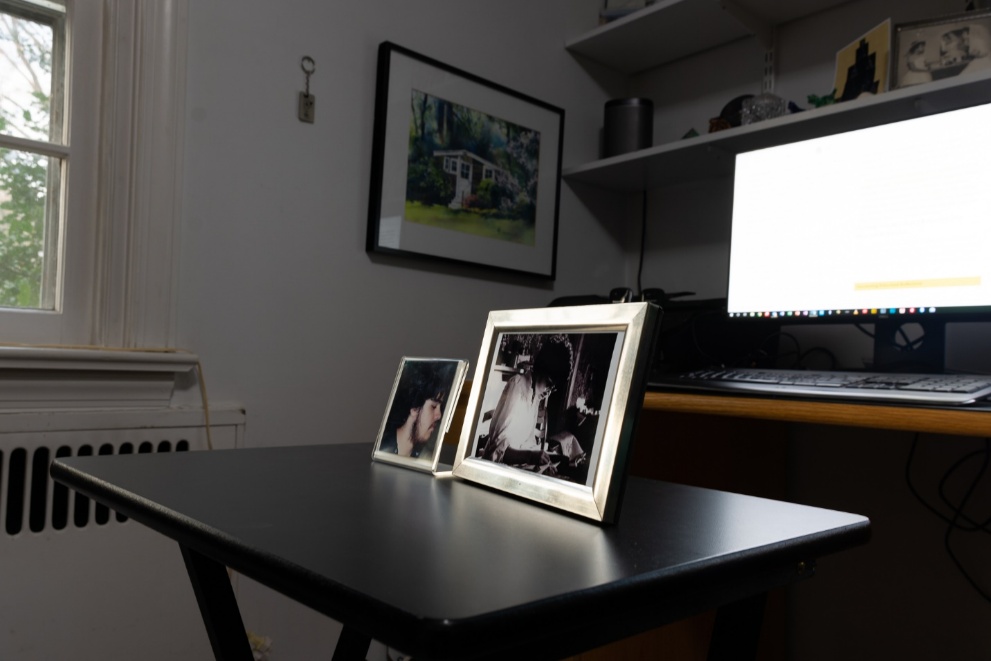
We now see:
- The computer monitor is brighter than before as is the reflection in the corner of the tabletop. In addition, a corner of the monitor is now clearly reflected in the picture on the wall, barely detectable in the first photo.
- The bright glare streak on the front edge of the table has been reduced.
- The plastic and glass faces of the two pictures on the table are clear and no longer glaring, though the metal frame of the picture on the right is still pretty bright.
The polarizing filter in this position has helped some but it has also worsened some things. The next image is with the polarizing filter rotated a bit more.
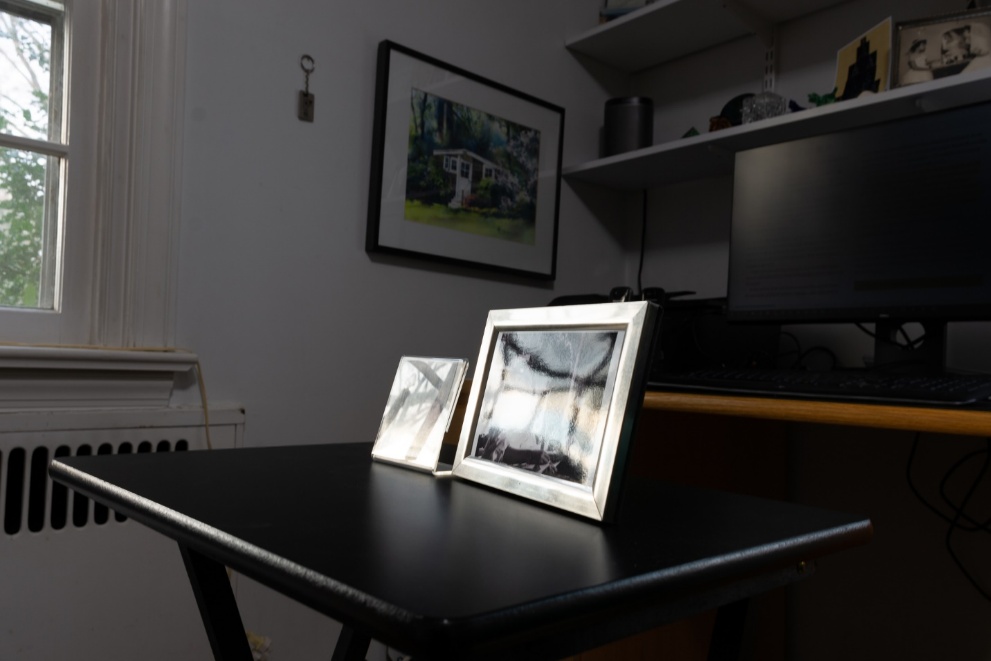
- The computer monitor and its reflections are now black. This is because light from LED screens is polarized. Note the monitor is not perfectly black because of reflections from other light sources.
- The glare of the faces of the two pictures is back, though their reflections in the table top are reduced.
- The bright glare streak on the front edge of the table is back, with now a soft glare streak on the side edge of the table.
So, what does this mean regarding what a photographer can do to control glare?
- First, try reducing glare without polarization techniques in either of two ways.
- Soften the offending light source with a diffusion material.
- Move the camera or the object being photographed to reduce glare.
- Try reducing glare from reflection on a non-metallic surface by a polarizing filter on the lens. This may not work well with multiple diffused surfaces or with multiple light sources, all causing different directions of polarization.
- Glare from a metallic surface might require polarizing the light source, if feasible. Either use a polarized source, like a computer screen, or alternatively, use a polarizing gel on the light. Either way, a polarizing lens filter on the camera allows control of the amount of polarized light.
- Some level of glare is useful for enhancing contrast of a surface by highlighting some parts of the surface more than others. In that case, polarizing filters can be used to partially eliminate some of the glare that completely obscures the surface.
- For outdoor photographs, where light is usually partially polarized causing a hazy appearance, a polarizing lens can reduce the washed-out look.
Finally, it should be clear by now that it may not be possible to control all the sources of glare as cleanly as you would like, using diffusion, moving the camera or objects, or with polarizing filters. Sometimes you just cannot control all the reflections in a complex scene, and you either do the best you can or maybe try to clean it up in post-editing. Sometimes you should just walk away from the photo.
Carl Finkbeiner
Mobile: 610-551-3349 website instagram facebook linkedin digitalphotoacademy